You Actually Need Two Pillows to Sleep Well — One for Your Head, One for Your Legs
By SPOLBAN Team··Updated ·6 min read

Adapted from health reporting by People's Daily Health, citing clinicians at the Third Affiliated Hospital of Guangzhou Medical University and the First Affiliated Hospital of Guangzhou University of Chinese Medicine. For general education only — not a substitute for individual medical advice.
Eight Hours of Sleep, and You Still Wake Up Aching
You slept a full seven or eight hours. You wake up with a sore neck, stiff shoulders, an uncomfortable lower back — if it isn't aching in one place, it's aching in another.
Why does the body feel tired after a night of rest? Often the answer is simple: most people are using their pillow wrong, and most people are using one pillow when they need two. One goes under the head. The other goes somewhere most people never think to put it.
Why Two Pillows
Walk into any hotel room and you'll find two pillows on the bed. That isn't decoration.
The human spine has natural curves. When only your head is propped up, your neck and lower back are often left "working overtime," unsupported in mid-air. A more sensible arrangement follows the body's actual shape:
- Pillow one goes under your neck — not the back of your skull.
- Pillow two goes under or between your legs, to relieve pressure on the lower back.
If you sleep on your back: put a pillow under your knees
Lying flat with the legs straight leaves a gap between the lower back and the mattress. The lower-back muscles have to keep working to hold the body balanced. Over hours, those muscles fatigue and pressure on the lumbar discs rises — which is its own source of pain.
Placing a pillow under the knees helps maintain a healthy spinal curve and relieves disc pressure.
If you sleep on your side: put a pillow between your knees
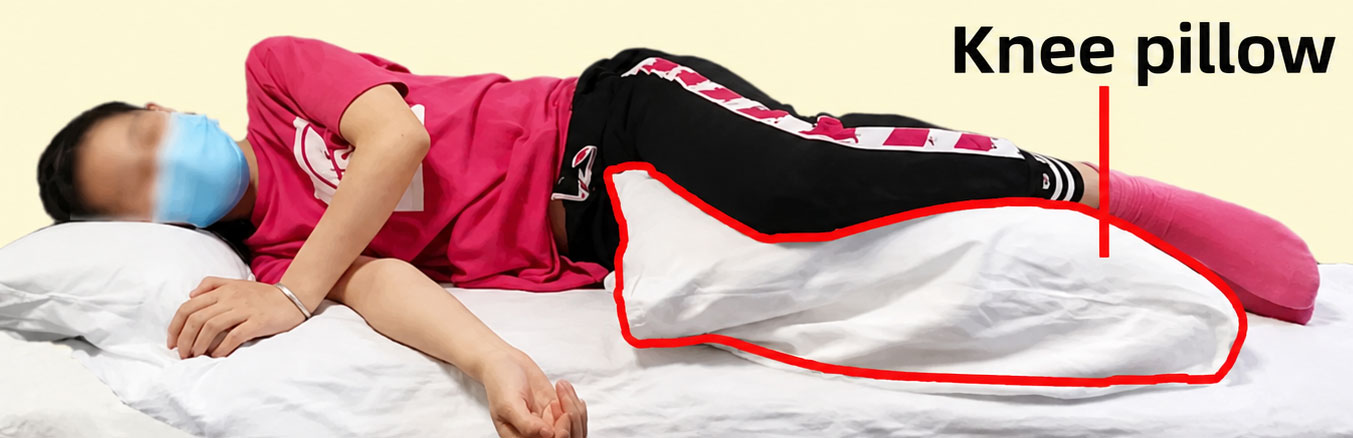
Tucking a pillow or folded blanket between the knees helps prevent the spine from twisting sideways. The head pillow should match the height of your shoulder. Alternate which side you sleep on rather than always favouring the same one.
It's a small change, but it lets the sleeping posture follow the body's natural curves, and the spine can finally lengthen out.
Three Ways People Get Pillows Wrong
Most households don't lack pillows — they just don't use them well. These three mistakes are extremely common.
❌ 1. Resting only the back of the head on the pillow
This is the most common error and the easiest to overlook. When only the skull sits on the pillow, a gap opens between the shoulders and the cervical spine, and the neck muscles never relax all night.
A pillow is meant to support the neck. Its core job is to fill the space between your head-and-neck and the mattress, supporting the cervical spine through the night and maintaining its normal curve.
❌ 2. A pillow that's too high
The cervical spine has a natural forward curve — a gentle "C." During the day, long hours looking down at phones and desks already hold it in an overstretched position. At night, the wrong pillow means the neck doesn't rest at all; it keeps taking load.
An over-high pillow effectively holds your neck in a "looking down" posture all night, chronically straining the muscles and ligaments at the back of the neck. Research cited in the original report associates pillow heights above 12 cm with a 67% increase in cervical spine problems.
More seriously, a case-control study in the European Stroke Journal — which named the phenomenon "Shogun pillow syndrome" — found the risk of spontaneous vertebral artery dissection rose with pillow height, particularly above 12 cm.
For most people, a slightly-too-high pillow is only a comfort issue. But for someone who already has cervical spine disease, chronic neck and shoulder strain, or narrowed blood vessels, the stakes are higher. The original report describes a 65-year-old man in Hangzhou with long-standing neck and shoulder pain who, having heard that "cervical spine problems need a high, firm pillow," switched to one. After nearly a month his neck discomfort steadily worsened, and he suffered a stroke. His doctors considered the pillow a likely contributing factor.
If you have existing neck or shoulder problems, treat your pillow as a real variable, not an afterthought.
❌ 3. A pillow that's too low
Too low — or no pillow at all — tips the head and neck too far back, exaggerating the cervical curve and overtightening the muscles and ligaments at the front of the spine. That causes chronic strain just as surely as a pillow that's too high.
What Height Should Your Pillow Actually Be?
Choosing a pillow isn't complicated. Remember the one-fist rule.
✅ Lying on your back. The pillow's compressed height should roughly equal the height of your own fist (measured across the closed fist, thumb-side up). Your chin should stay level — neither tipped toward the ceiling nor tucked toward your chest. For most adults this lands around 8–12 cm.
✅ Lying on your side. The pillow height should equal the width of one shoulder, so that head, neck, and spine form a straight line. For most adults, around 10–15 cm.
On materials, buckwheat hull, memory foam, and latex are all reasonable choices. What matters is that it's neither too soft nor too firm and that it genuinely supports. If the height suits you and you use it correctly, an ordinary pillow is entirely sufficient.
If you have the option, a contoured pillow — lower in the middle, raised at the edges — accommodates both back and side sleeping more comfortably.
One last thing: a pillow is not an heirloom. Spring, buckwheat, and memory foam pillows all have a service life. When a pillow loses its resilience, stops providing real support, or shows obvious deformation after two to three years, replace it.
TLDR
- The pillow supports your neck, not the back of your head.
- Add a second pillow — under the knees on your back, between the knees on your side.
- Use the one-fist rule for height: roughly 8–12 cm on your back, 10–15 cm on your side.
- Replace it every two to three years.
If you regularly wake with neck pain, dizziness, or numbness in the arms or hands that doesn't settle after you've corrected your pillow setup, have it assessed rather than continuing to experiment.
Sources
- Third Affiliated Hospital of Guangzhou Medical University, 2025-09-16
- First Affiliated Hospital of Guangzhou University of Chinese Medicine, 2026-08-20
- High pillow and spontaneous vertebral artery dissection: A case-control study implicating "Shogun pillow syndrome." Eur Stroke J. 2024 Jun;9(2):501–509. PMID: 38284382
- Dushi Kuaibao / Orange Persimmon Interactive, 2026-07-12
- Guang'anmen Hospital, China Academy of Chinese Medical Sciences, 2026-09-04